English translation for web publication
Publication metadata: Published in May 2026
Original publication date: 8 May 2026
Original source: Finnish National Agency for Education (Opetushallitus)
————————————————————————————————————————————————
On Europe Day, we celebrate peace and cooperation in Europe and recall the historical background to the creation of the European Union.
Juha Ketolainen, Mira Länsikallio and Pirjo Pehkonen
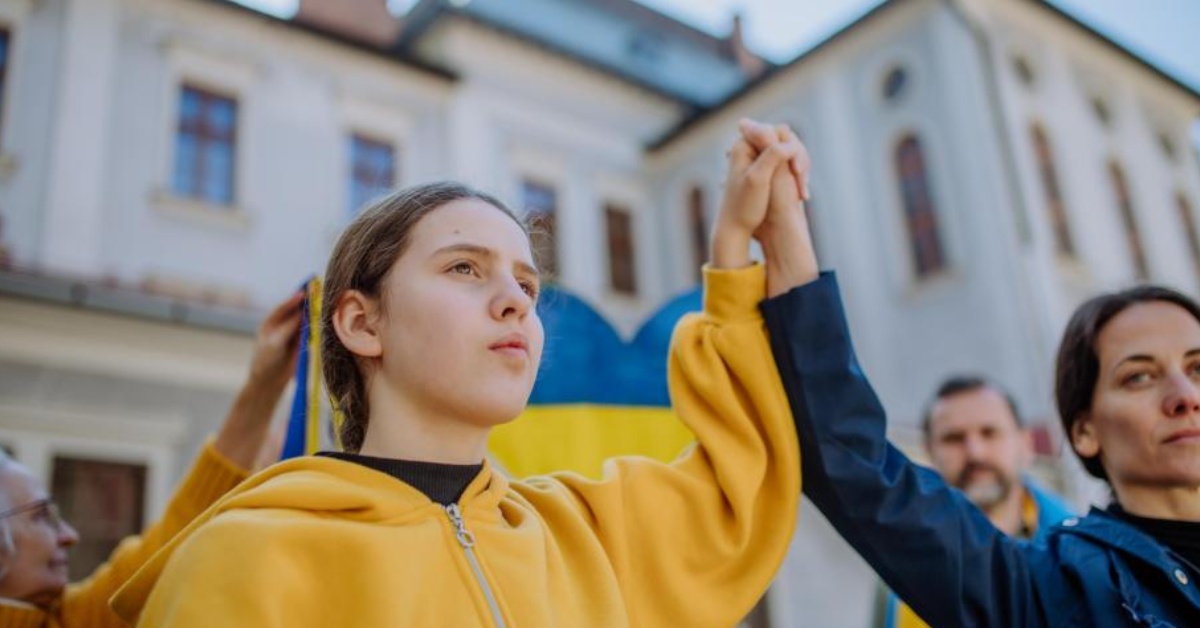
Photo: Getty Images – Halfpoint Images
On 9 May 1950, French Foreign Minister Robert Schuman presented a proposal to place French and West German coal and steel production under a common supranational authority. The idea was that by pooling the industries that were essential for waging war, war between European countries would become impossible. The declaration is regarded as the starting point of European integration.
Europe Day is also a good opportunity to highlight how the European Union’s Erasmus+ programme supports Ukraine, which is suffering from Russia’s war of aggression, and helps build a shared European future for the time when the war is over. The support is directed at learners, teachers, schools, educational institutions and higher education institutions, as well as actors in the youth and sports sectors, both in Ukraine and in EU countries.
The figures are impressive. Since 2022, more than 52,000 Ukrainians have participated in Erasmus+ mobility activities, helping them to continue their studies, develop professionally and maintain connections with European partners. More than EUR 208 million has been used for this purpose. Part of the funding has supported, among other things, language training, psychosocial support and the recognition of studies in host countries. Approximately EUR 70 million has been allocated to 375 cooperation projects that support, for example, curriculum reform, the digital transition and the restoration of educational institutions’ operational capacity.
The programme has also enabled the production of a wide range of learning materials in Ukrainian. In addition, through the eTwinning network, Ukrainian teachers and teachers working with Ukrainians have access to peer support, continuing professional development and materials. Erasmus+ and European Solidarity Corps projects support the integration of young people, media and civic skills, and the resilience of communities.
| “The natural next step in expanding Erasmus+ cooperation would be Ukraine’s full participation in the Erasmus+ programme through an association agreement.” |
Finnish organisations have actively participated in Erasmus+ cooperation to support Ukraine. Two good examples are the projects coordinated by Seinäjoki Joint Municipal Authority for Education, Sedu, and Savonia University of Applied Sciences: Integrating Ukrainians to VET (U2VET) and Supporting Trauma-Informed Higher Education Practices (STEP).
In Ukraine, the effects of war on studying and learning are a daily reality. The primary objective of the STEP project is therefore to strengthen trauma-informed pedagogy among higher education teachers by developing a research-based training package and pedagogical guidelines. Cooperation with Khmelnytskyi National University (KhNU) has provided insight into higher education in a country at war. Everyday routines provide stability. Work continues and students are educated despite electricity restrictions and air-raid alerts. The project outputs will be piloted in Ukraine, benefiting the teachers who take part while also providing valuable information to support further development work.
U2VET, in turn, is a European cooperation project managed by Sedu. Its aim is to compile good practices into digital guides, particularly to support Ukrainians in applying for vocational education and training and in integrating into education, working life and society. Throughout the project, all partners have shown a strong commitment to helping Ukrainians while openly developing their own practices at the same time. However, integration does not mean the same thing everywhere. In some countries, newcomers are expected to adapt quickly and participate actively, while in others coexistence is regarded as a sufficient goal. Despite these differences, the shared objective has also strengthened the network and friendships between the participating organisations.
Alongside the EU and Erasmus+, EU Member States have a number of their own initiatives with the same purpose. For example, the Finnish National Agency for Education has several activities supporting the reconstruction of Ukraine. These include the Ministry for Foreign Affairs-funded Bridge2Skills project to develop vocational education and training in Ukraine, cooperation between public authorities through the Learning2gether2 project in general upper secondary education, education export activities under the Education Finland programme, and Ukraine projects under the Team Finland Knowledge programme, which support networking and cooperation between Finnish and Ukrainian higher education institutions.
The natural next step in expanding Erasmus+ cooperation would be Ukraine’s full participation in the Erasmus+ programme through an association agreement. Minister of Education Anders Adlercreutz recently also advocated this in a joint article with a fellow party leader from Sweden. In any case, such a step would support both the reform of Ukraine’s education system and, more broadly, the country’s path towards EU membership.
Authors
Juha Ketolainen
Senior Specialist, Finnish National Agency for Education
Mira Länsikallio
Acting Project Manager, U2VET project, Seinäjoki Joint Municipal Authority for Education, Sedu
Pirjo Pehkonen
Project Manager, STEP project, Savonia University of Applied Sciences